Cartography of Longing: The Fantasy Maps of the Digital Ummah
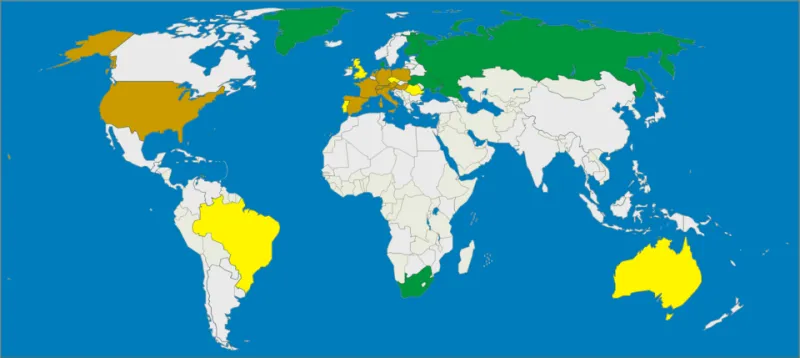
Photo: VYGOcommons, CC BY-SA 3.0, via Wikimedia Commons
Scroll long enough through the digital spaces where young American Muslims gather, and you will encounter a peculiar genre of political art. A map of the world, rendered in muted greens and golds, with a single shaded bloc stretching from Rabat to Jakarta. A mock cabinet list, complete with a minister of finance and a director of foreign affairs. Memes of a resurrected dinar displacing the dollar. None of it corresponds to any state on earth. All of it circulates with remarkable energy among second-generation Muslims in Chicago, Dearborn, and Northern Virginia.
This is the cartography of longing — and it deserves more serious attention than mockery or alarm.
The Grammar of Imagination
Political scientists have long understood that nations are, as Benedict Anderson observed, imagined communities. What is striking about the maps circulating in American Muslim digital spaces is how self-consciously imaginary they are. The creators know, usually better than their critics, that no such state exists. The map is not a plan of campaign. It is a diagram of an idea.
Consider what the fantasy map actually does. It collapses the artificial borders drawn by Sykes-Picot and its successors into a single continuous territory. It renders the ummah — a theological reality Muslims affirm in prayer five times daily — as a visible, mappable object. In a country where Muslim identity is often reduced to a demographic checkbox or a security category, the map insists on something larger: a political community with a memory, a jurisprudence, and a destiny.
Institutions Without Territory
Yet the same community drawing these maps is, in practice, engaged in something far more prosaic and far more interesting. American Muslims have built charter schools and halal certification bodies, estate planning practices and zakat funds, voter guides and mosque associations. These are institutions without a capital, governance without a flag.
The tension is instructive. The classical jurists distinguished between the adab of the individual, the obligations of community, and the structures of state. Much of what American Muslims are building sits squarely in the second category — and arguably always has. The fantasy map, then, may be less a blueprint than a placeholder: a way of insisting that the institutions being built now are not assimilation by another name, but the early scaffolding of a civilizational project.
Why the Longing Persists
Skeptics within the community — and there are many — worry that map-making substitutes for institution-building, that the dopamine of a viral graphic crowds out the slow work of endowments and school boards. The worry is not baseless. A politics of the screenshot can become a politics of the spectator.
But longing is not the enemy of construction; historically, it has been its fuel. The diaspora communities that eventually built durable institutions almost always began with an imagined homeland held together by print, ritual, and now pixels. The question for American Muslims is not whether to abandon the map, but whether the map can be subordinated to the work — whether the imagined caliphate can discipline, rather than distract from, the unglamorous labor of zakat governance, arbitration councils, and civic coalition-building.
Reading the Map Correctly
There is a final irony worth naming. The critics who treat these graphics as a fifth-column threat misread them precisely as the most naive enthusiasts do: as literal territorial claims. Both mistake a symbol for a survey. What the map encodes is a claim about legitimacy — the conviction that sovereignty belongs to God, that law should answer to revelation, and that the current arrangement of nation-states is neither natural nor final.
That conviction can be held, and in America largely is held, within the ordinary disciplines of constitutional life: voting, organizing, litigating, building. The map that doesn't exist may yet point, not to a border to be crossed, but to a standard to be met. For a community learning to govern itself without a state, that standard — patiently, locally, institutionally — may be the most realistic thing in the room.